How to Start Decluttering When Overwhelmed

Affiliate disclaimer: Some links on this blog are affiliate links (Amazon included), meaning I may earn a commission at no extra cost to you.
When you’re standing in the middle of a room full of years’ worth of “stuff,” being told to “just start” can feel like climbing Everest in flip-flops. Overwhelm is a physical sensation, characterized by a racing heart, foggy brain, and paralysis that keeps you on the couch.
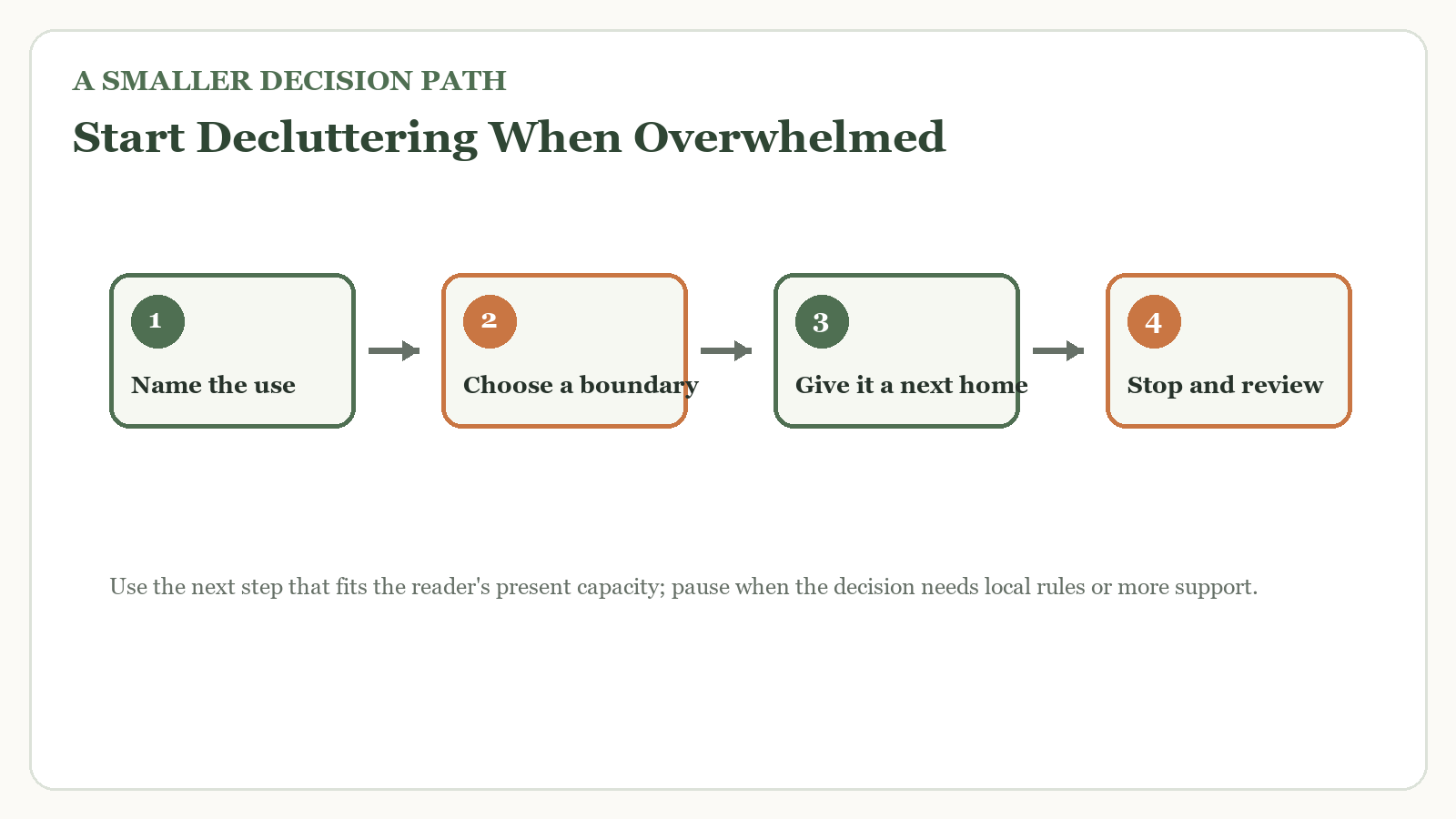
If you are feeling stuck, don’t reach for a trash bag yet. Reach for a different strategy. Here is how to break the paralysis and start decluttering when you’re completely overwhelmed.
1. Identify the “Trash-Only” Layer
The reason we feel overwhelmed is often decision fatigue. Every item asks a question: Should I keep this? Will I need it later? Who gave this to me? Lower the stakes by starting with the only category that requires zero emotional labor: Literal Trash.
- Walk through the room with a bag and look only for things that are broken, empty, expired, or actual garbage (wrappers, old mail, scraps of paper).
- Why it works: You aren’t “decluttering” yet; you’re just clearing the field. It’s an effortless win that provides immediate visual relief.

2. Use the “Hula Hoop” Method
When an entire room is messy, your eyes dart from one pile to another, making it impossible to focus.
- The Strategy: Use a hula hoop, a piece of string, or even a towel to mark off a tiny 3-foot circle on the floor or a single corner of a counter.
- The Rule: Your entire world is now inside that circle. Do not look at the rest of the room. Do not contemplate the closet. Please focus on managing what is within the hoop.
- Why it works: It physically limits your field of vision, which shuts down the “big picture” panic in your brain.
3. The “No-Touch” Rule for Decision Making
Research indicates that the moment we touch an object, we begin to feel a sense of ownership and attachment to it. This makes letting go significantly harder.
- The Strategy: If you have a friend or family member helping, have them hold up the items. You simply sit back and say “Keep,” “Donate,” or “Trash.”
- Why it works: It creates psychological distance. When you aren’t physically bonded to the item, you can make a more objective, logical choice.
🧠 Mindset Shifts for the Overwhelmed
| The Thought | The Reframe |
| “I’m wasting money by throwing this away.” | The money is already gone. Keeping the item is now just “charging you rent” in the form of stress and space. |
| “I might need this one day.” | If you can replace it for less than $20 in less than 20 minutes, let it go. Your space holds greater value than an item that you might need in the future. |
| “I have to finish the whole room today.” | Done is beyond perfect. 15 minutes of progress is a 100% improvement over zero minutes. |
4. Create a “Safe Passage” for Items
Sometimes the overwhelm comes from the guilt of “wasting” things. Knowing the exact destination of an item makes it easier to release it.
- Pick your “Port”: Before you start, decide on a specific charity or a friend who would love your items.
- The “Limbo” Box: If you’re truly panicked about a decision, put the item in a box labeled with a date 3 months from now. If you don’t open that box by that date, donate the whole thing without looking inside.
5. Stop Before You’re Exhausted
Working until you reach a wall is the greatest mistake. If you stop when you still have a little energy left, you’ll be much more likely to return to the task tomorrow.
- Set a “Hard Stop” Timer: Give yourself 20 or 30 minutes. When the timer dings, you are legally obligated to stop, even if you’re on a roll.
To create the perfect “Micro-Goal” list, I’ve broken down the most common “problem rooms.” Pick the one that is stressing you out the most right now and follow the steps in order.
The rule is: Do not move to Step 2 until Step 1 is 100% finished.
Option A: The “Avalanche” Closet
Focus on the floor first—it’s the foundation of the room.
- Clear the Floor: Pick up everything touching the floor. If it’s trash, toss it. If it’s dirty laundry, put it in the basket.
- The Shoe Sort: Line up all your shoes. If a pair is broken or painful, put it in a “Donate” bag.
- The “Empty Hanger” Hunt: Slide all your clothes to one side and pull out every empty hanger. Bundle them up.
- The 10-Item Toss: Grab the first 10 items on the rack you know you don’t wear. Don’t think; just bag them.
Option B: The “Chaos” Kitchen
Focus on the “Work Zone” where you actually prep food.
- Clear the Sink: Do the dishes or load the dishwasher. An empty sink changes the entire mood.
- The Countertop Reset: Move everything that isn’t a daily-use appliance (like the toaster) into a cabinet or a “to-sort” box.
- The Mug Cull: We all have too many mugs. Pick your favorite five, and put the rest in a donation box.
- The Fridge Front: Remove every magnet, menu, and note from the front of the fridge. Only put back what is current.
Option C: The “Drowning” Home Office/Desk
Focus on visual clarity to help you think.
- The Paper Pile-Up: Gather every loose piece of paper into one stack. Don’t sort yet—just stack them so the desk surface is visible.
- The Pen Test: Grab a scrap piece of paper and scribble with every pen. If it doesn’t work immediately, please discard it.
- The Tech Tangle: Pick up every cord. If you don’t know what it charges, put it in a “Mystery” bag. If it’s frayed, toss it.
- The Desktop “Desktop”: Delete 10 files from your computer screen that you don’t need.
Option: D: The “Stressful” Bathroom
Focus on hygiene and expiration.
- The Medicine Sweep: Open the cabinet and pull out anything expired. (Check the back!)
- The “I’ll Never Use This” Bag: Take those half-used hair products or makeup colors that didn’t suit you and put them in the trash.
- The Towel Fold: Fold your clean towels neatly. If you find one with holes or bleach stains, move it to a “cleaning rags” pile.
- The Counter Clear: Wipe the sink and mirror. Only keep soap and toothbrushes on the counter.
📝 Your Micro-Goal Strategy
If you’re feeling extra overwhelmed, try the “Rule of 3”:
- Throw away 3 pieces of trash.
- Put away three items that have a home.
- Donate three items you no longer need.
Final Thoughts: One Small Step is Still Progress
When you’re standing at the foot of a mountain of clutter, it’s easy to feel like anything less than a total overhaul is a failure. But the truth is, decluttering is a practice, not a project. Overwhelm thrives on the belief that you must do everything at once. By focusing on a single hula-hoop-sized area, a 5-minute timer, or a “trash-only” sweep, you can reclaim your home one square inch at a time. Every item you remove is a small victory for your mental health and a step closer to a more peaceful life.
Don’t wait for the “perfect” time or a sudden burst of energy that may never come. Start where you are, use what you have, and do what you can. Tomorrow’s version of you will be so grateful that you started today.
Here’s my take: Start with one drawer. Just one. That’s how systems survive reality.
[…] time, and mental energy. When you keep a $5 item “just in case,” you are essentially paying more in “rent” (stress and clutter) over the years than the item is actually […]